
Nevada County Court Records After Arrest
Nevada County court records after a jail arrest are not the same record as the sheriff's in-custody report. The booking side starts when a person is taken to Wayne Brown Correctional Facility and entered into local jail systems. The court side starts when the Nevada County District Attorney reviews the law-enforcement reports and files, rejects, amends, or delays formal charges. That decision is what creates the criminal case record in Nevada County Superior Court. A reader may see one set of suspected offenses at booking and a different set of filed charges once the prosecutor has reviewed police reports, witnesses, evidence, and any warrant or hold information.
The sheriff's current custody report is still useful because it can identify the person, booking timing, and possible arrest date before a court case appears. For custody status and booking details, use Nevada County jail inmate records. For booking-photo questions, use Nevada County jail mugshots. Court records after a Nevada County arrest should be read as the formal case track: filed counts, court dates, warrants issued by the judge, disposition, sentence, and public documents when the clerk makes them available.
Search Nevada County Arrest Court Records
The official court path is the Superior Court of California, County of Nevada and its Nevada County Superior Court eCourt public portal. The criminal division is the local court division for criminal case information, while the court's criminal self-help page explains some case-process topics for people dealing with a pending matter. The eCourt portal is the first online place to look for filed court records after a jail arrest, but it is not a police report system and it is not a statewide criminal-history search.
- Use the sheriff's in-custody report first if the arrest is very recent and the person may still be in Wayne Brown Correctional Facility.
- Open the Nevada County eCourt portal and search by case number if one is known from court paperwork, citation papers, or attorney notice.
- Search by defendant name when no case number is known, and use criminal case filters if the portal presents them.
- Open the case result and compare the filed charges, hearing dates, and case status against the jail booking information.
- Contact the court clerk for older records, documents not available online, or cases that need clerk review before release.
The research identified a limited portal field set rather than a detailed public form manual. Case number is the cleanest search path when available. Party-name search helps when the case number is unknown, but spelling, aliases, hyphenated names, and date filters can matter. If no court record appears right after the arrest, the reason may be timing, a filing decision by the District Attorney, a sealed or confidential matter, an out-of-county case, or a different name spelling.
The court eCourt portal was captured as a successful manifest image from its official public case-search page at Nevada County Superior Court eCourt.
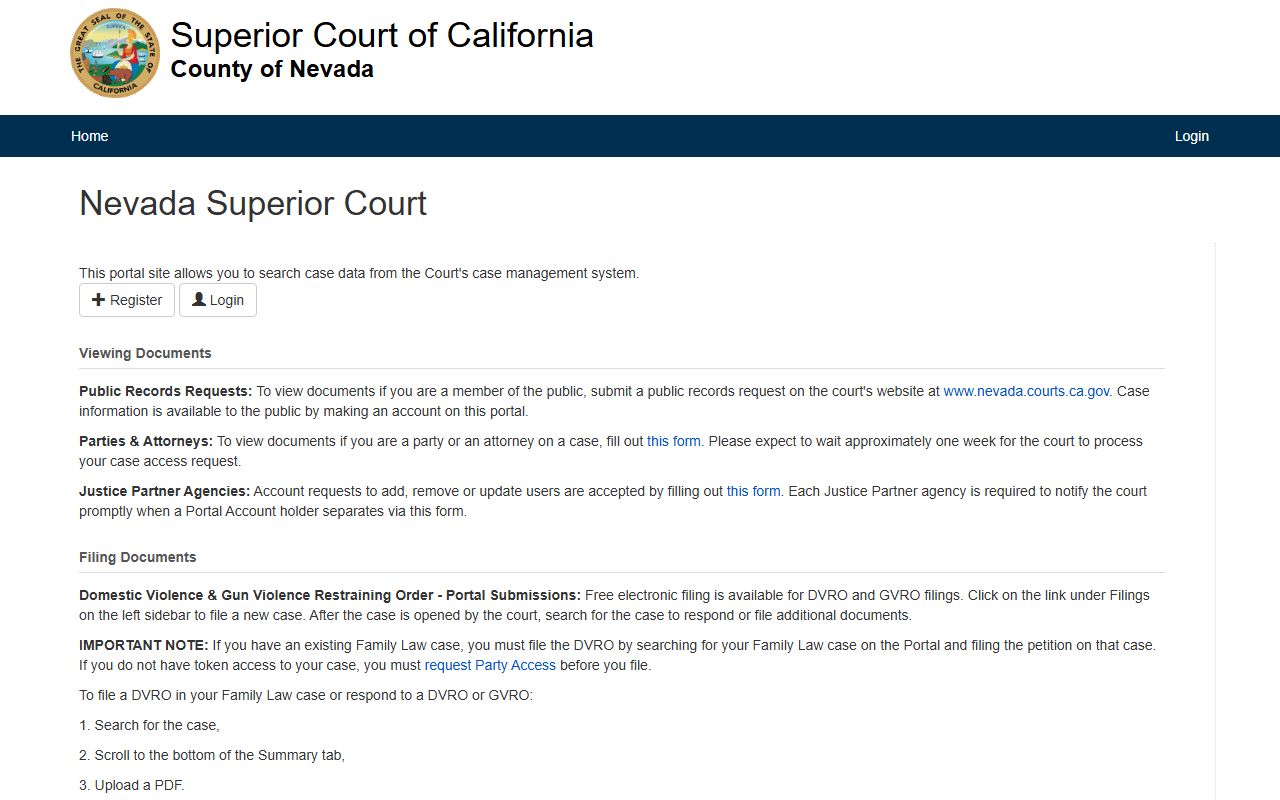
The screenshot fits the arrest-to-case workflow because eCourt is the public channel for filed case records after the jail and prosecutor steps have occurred.
Nevada County Court Search Fields
Nevada County court records after arrest are easiest to review when the searcher knows the case number. The portal also supports party-name search routes, and the public interface may present case-type or date filters depending on the search path. These fields should be used with care because the public court case is separate from the booking record. A jail charge can be a custody reason before the prosecutor has made the final filing decision.
| Field Label | Type | Required | Notes |
|---|---|---|---|
| Search or case search | Portal search | Route-dependent | Public eCourt access starts from the portal home and may vary by search route. |
| Case Number | Text | No | Best when known from court notice, citation paperwork, jail paperwork, or attorney records. |
| Party Name | Text | No | Use defendant name spelling variants if the first search does not find the criminal case. |
| Date range or case type | Filter | No | Use criminal case filters when the portal exposes them. |
Nevada County Arrest Charging Documents
The path from arrest to court record runs through prosecutor review. The Nevada County District Attorney receives law-enforcement reports and decides which charges, if any, to file in Nevada County Superior Court. The office's official department overview says the District Attorney prosecutes felony and misdemeanor offenses referred by law-enforcement agencies, and its criminal-justice process page explains that prosecutors review case facts before deciding which charges to file. That is why a booking offense can be changed, replaced, or not filed after review.
The main charging documents are the complaint, information, and indictment. A complaint is common at the start of a California criminal case. A felony may later proceed through preliminary-hearing steps and an information. An indictment is a grand-jury charging route and is different from a complaint. Once a charging document is filed, the court record can show the case number, count numbers, code sections, hearing dates, and later disposition if the information is public.
| Document | Common Use | What It Does |
|---|---|---|
| Complaint | Common initial criminal filing | Starts the filed court case and lists the charges the prosecutor brings after review. |
| Information | Felony cases after preliminary proceedings | Sets out felony charges that proceed after the early court stage. |
| Indictment | Grand-jury charging path | Charges a case through a grand jury rather than the usual complaint path. |
District Attorney source material was also captured from the official Nevada County page at Nevada County District Attorney.
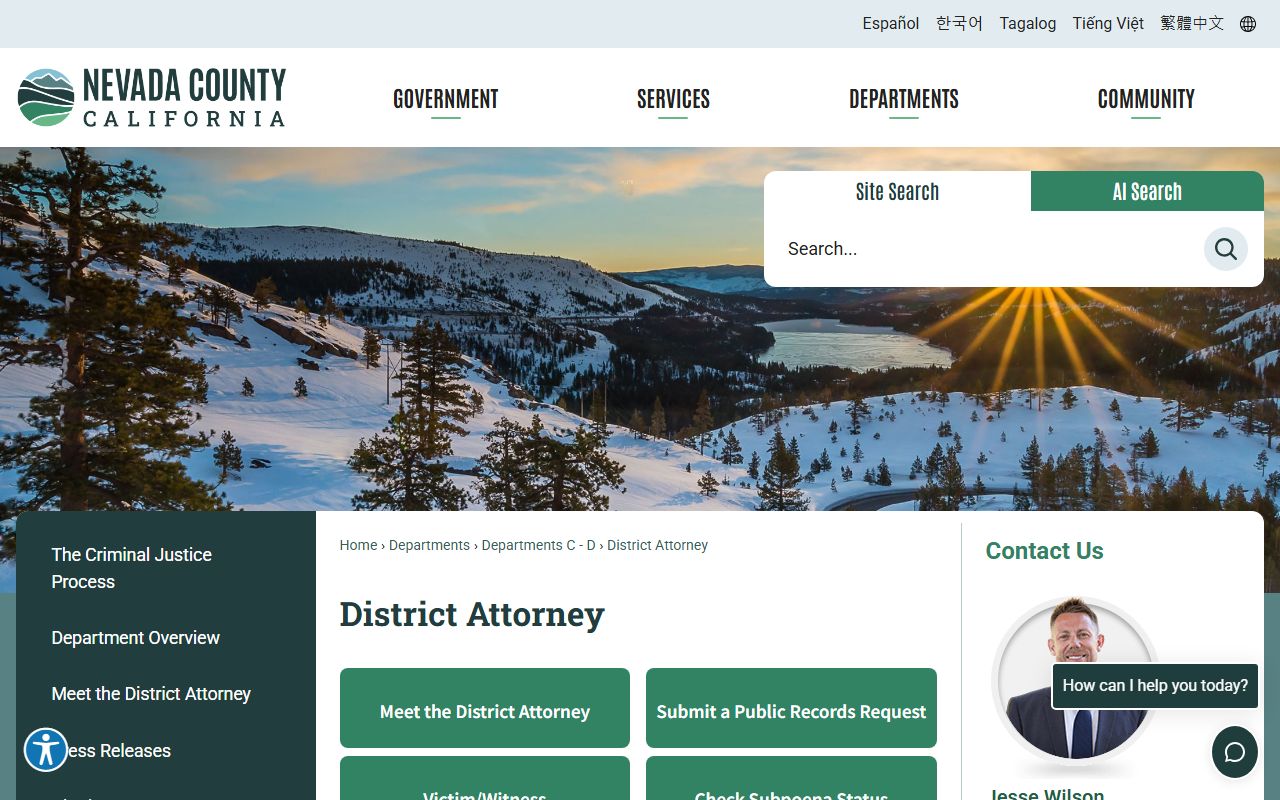
The prosecutor source matters because filed court charges come from District Attorney review, not from the jail roster alone.
Nevada County Charge Status
Charge status is where many Nevada County court records after arrest become confusing. A status line can show that a charge is pending, dismissed, amended, reduced, or resolved by plea or verdict. Some portals use local status terms, and some details may appear only in docket events or clerk documents. The key rule is simple: arrest and booking charges are the starting point, not the final word. Filed counts may be narrower, broader, or framed under different California code sections after prosecutor review.
| Status | What It Means |
|---|---|
| Pending | The charge is still active in the court case and has not reached a final public disposition. |
| Amended or reduced | The prosecutor or court record reflects a changed count, lesser offense, added allegation, or revised code section. |
| Dismissed | The charge was dropped by court order or prosecutor action, though other counts in the same case may remain. |
| Rejected or not filed | The District Attorney did not file that booking charge as a court count, so it may not appear as a filed charge. |
| Disposed | The charge has reached an outcome such as plea, conviction, acquittal, dismissal, diversion, deferred entry, or sentence. |
California Department of Justice criminal-history files are different from the local court index. Penal Code section 13300 limits dissemination of state summary criminal-history information, so the general public should not expect a free statewide name search for all criminal-history entries. For public filed Nevada County charges, use the local court portal or the clerk.
Nevada County Bond After Arrest
Bond and release information may appear on jail records, court records, or both, but the meaning depends on the stage of the case. The Nevada County bail and bond page is the local source for bail questions tied to Wayne Brown Correctional Facility. A person may be released by citation, own recognizance, cash bail, surety bond through a licensed bail agent, court order, sentence completion, or no-file release. A hold can block release even when one charge appears bailable.
| Release Type | How It Works |
|---|---|
| Cash bail | The full amount is posted, then handled under court rules after the case obligations are met. |
| Surety bond | A licensed California bail agent posts bond for a premium or fee. |
| Own recognizance | The court releases the person on a promise to appear, often with conditions. |
| No-bail or hold | A warrant, probation hold, parole hold, federal hold, immigration detainer, or court order prevents ordinary release. |
Before paying bail, confirm current custody with Wayne Brown Correctional Facility at 530-265-1291, confirm the case or booking identifier, and ask whether another hold exists. California still uses bail schedules and bail agents, but courts must account for current law when setting detention or release conditions. A court order can change release terms after the roster was viewed.
Nevada County Arrest Warrants
The research did not locate an official Nevada County sheriff active-warrant public search page. Warrant questions should therefore be routed through court records, direct court or law-enforcement contact, and public-record channels where release is lawful. A warrant can lead to a booking at Wayne Brown Correctional Facility, and the person may appear on the in-custody report while physically held there. Once released, transferred, or cleared, the jail roster may no longer show them.
Bench warrants are often tied to failure to appear or violation of a court order. Arrest warrants are usually tied to probable cause or charging papers. Search warrants are different and may remain confidential during an investigation. A fugitive or out-of-county warrant can create a hold that changes bail and release timing. Do not use a rumor or search result to confront a person. For warrant resolution, the safer path is attorney advice, court confirmation, and official appearance instructions.
Charges vs Convictions
An arrest and a filed charge are accusations, not proof that a person committed the offense. A conviction is a later court outcome after a guilty plea, no contest plea, or trial verdict. Nevada County court records after a jail arrest should be read with that sequence in mind. A case can show filed charges for weeks or months before any final disposition exists, and some counts may be dismissed while others continue.
| Point | Charge | Conviction |
|---|---|---|
| Stage | Accusation filed in court after arrest review | Final outcome from plea or verdict |
| Proof level | Based on probable cause and prosecutor filing decision | Requires a plea or proof beyond a reasonable doubt at trial |
| Record meaning | Shows what the state alleged at that point | Shows a formal finding or admitted offense |
Sealed vs Expunged Records
California public-access law does not make every arrest or court record visible forever. Juvenile matters, sealed cases, protected victim information, medical details, confidential law-enforcement information, and active-investigation material may be withheld or redacted. Government Code section 7923.610 requires disclosure of certain arrest information but preserves investigatory and safety exceptions. Penal Code section 13300 also limits state summary criminal-history dissemination.
| Point | Sealed | Expunged or Record Relief |
|---|---|---|
| Public view | Hidden or restricted from ordinary public access by court order or law | Relief may change how a record is reported or used, depending on the order and statute |
| Agency access | Courts and law-enforcement agencies may retain limited access | Some agencies may still see records for authorized purposes |
| Eligibility | Depends on case type, outcome, age, and California record-sealing rules | Depends on disposition, sentence, waiting periods, and current California law |
The research did not verify a specific California sealing statute for citation here, so a section number should not be guessed. Use the Nevada County Superior Court, court self-help resources, or legal counsel for case-specific record relief. A dismissal or sealing order may restrict official records, but it does not guarantee removal from all third-party copies that may have been made before relief was granted.
Nevada County Background Checks
Casual searches of jail and court records are not the same as a compliant background check. Employers, landlords, insurers, lenders, and other regulated users must follow federal and state law when using criminal-record information. A public court portal may help identify a case, but it may omit restricted documents, sealed matters, juvenile records, or state criminal-history data that is not available to the public.
Important: Nevada County Inmate Population is not a consumer reporting agency and may not be used for FCRA-covered decisions.
Restricted Nevada County Court Records
Restricted court records after a Nevada County arrest may include juvenile cases, sealed criminal matters, confidential victim or witness information, protected mental-health or medical details, and records tied to an active investigation. The same limits can affect booking records, arrest reports, mugshots, and police reports requested from the sheriff or another agency. A court portal result that looks thin does not always mean no records exist. It may mean the record is not public online.
For police reports and arrest reports, use the Nevada County public records request channel or the sheriff records path. For formal case records, use the court portal or clerk. For custody notification, VINELink can help with alerts, but it is not the record custodian. For sentenced state prisoners, use CDCR CIRIS; for federal custody, use the BOP inmate locator; for immigration detention, use ICE ODLS.
Public Record Search
Sponsored Results